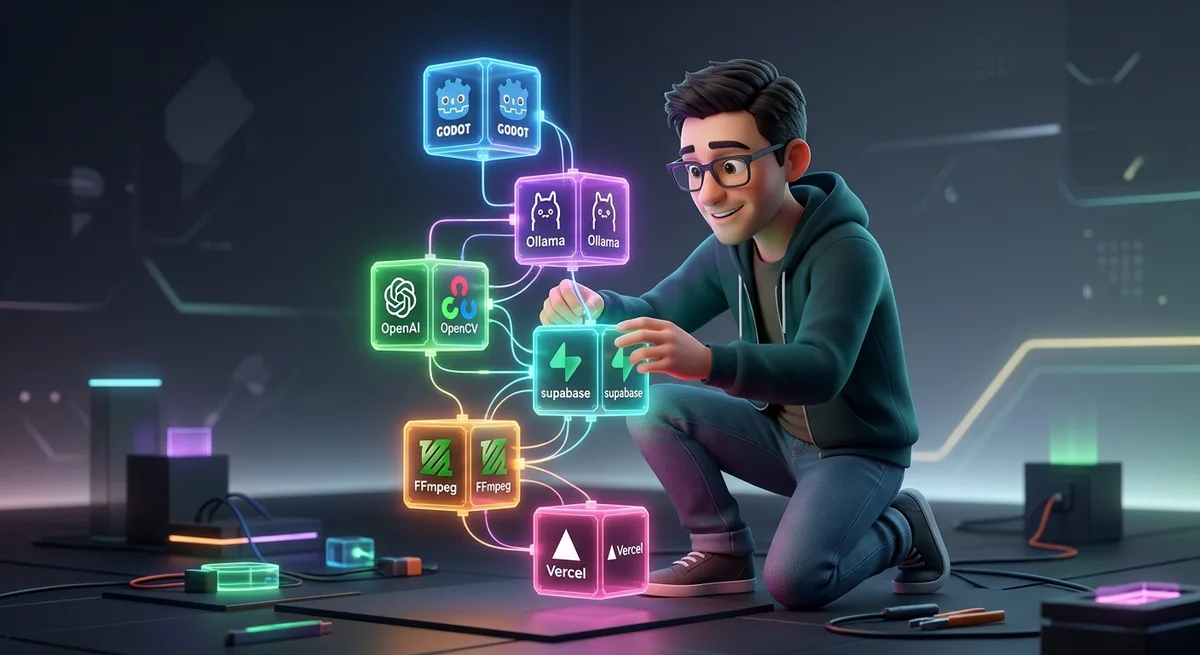
The Expectation Shift
You know Godot. Probably see it as an indie game engine. Know FFmpeg? You know it’s “for video editing”. OpenSCAD? “A tool for 3D printing”. OpenCV? “Academic computer vision”. Supabase? “Backend database”. Vercel? “Where you deploy”.
Each tool in its silo. Each with its “obvious” purpose. Exactly how most solopreneurs use them.
But here’s the problem: when you use Godot only for games, FFmpeg only for editing, and OpenCV only for image processing, you’re leaving 90% of each tool’s potential on the table. Worse — you’re missing the real competitive advantage, which doesn’t come from using the same popular tools everyone has access to, but from combining them in ways nobody else is exploring.
The true open source revolution isn’t about any single tool. It’s about how you architect them together to solve problems that traditional applications simply can’t touch.
Unconventional Stacks: The Core Concept
Let me be direct: powerful open source tools are commodities. Every developer has access to Godot, FFmpeg, OpenCV, Supabase. What differentiates a solopreneur building something unique from another building just another generic product is the combination.
Think of an unconventional stack as a layered system, where each layer plays a specific role within a larger architecture:
Perception Layer (OpenCV, MediaPipe, WebRTC) This layer captures real-world data. Not just static images — real-time video, sensors, data streams that describe the state of the world. OpenCV processes images with computer vision algorithms. MediaPipe offers pre-trained models for pose detection, hand tracking, face recognition. WebRTC brings real-time video streaming directly from browser or camera.
Most people use these tools for simple detection: “identify a face”, “detect a pose”. But what if you used them to feed real-time decisions in a larger system?
Simulation Layer (Godot, Three.js) Here you model the world. Godot isn’t just for games — it’s a complete simulation engine with 3D physics, lighting, particles, timeline. Three.js gives you capability to render 3D in the browser. This layer can simulate scenarios, test behaviors, create visualizations that aid understanding.
Generation Layer (OpenSCAD, FFmpeg) This is where you create artifacts — parametric 3D models, media files, content. OpenSCAD generates 3D geometry from code. FFmpeg transforms media into any format. This layer materializes decisions made in earlier layers.
Intelligence Layer (Ollama, local LLMs) You inject intelligence into the system. Not via paid APIs — via models running locally. Ollama lets you run LLMs on your machine without depending on OpenAI or cloud APIs. This layer makes decisions based on patterns, optimizes flows, learns from past data.
Orchestration Layer (n8n) It connects everything. n8n is a workflow engine that lets you connect APIs, trigger processes, coordinate actions between systems. You don’t write integration code — you draw workflows.
Backend Layer (Supabase) Persists state. Supabase is PostgreSQL + authentication + realtime + storage — everything you need to keep data alive. Not too generic, not too custom, but exactly the middle ground a solopreneur needs.
Distribution Layer (Vercel) Puts it all in the air. Vercel removes deployment complexity, offers edge functions, global databases, automatic scaling. Your system becomes accessible.
When you architect these layers together, you’re not building “an app”. You’re building a reality-creation engine — a system that perceives, simulates, decides, generates, persists, and distributes.
Case Studies: Where Unconventional Stacks Come Alive
Case 1: Visual Assistant for Athlete Training
The Real Problem
A coach wants to automate movement feedback for athletes. Film, manually analyze, send commented video — takes hours per week. He needs to scale, but can’t afford to hire more people.
The Unconventional Stack
OpenCV + Godot + Ollama + Supabase + Vercel
How It Works
- Athlete positions himself on camera (WebRTC captures video in real-time)
- OpenCV + MediaPipe detects body keypoints in real-time
- Godot simulates an “ideal skeleton” based on pre-captured correct movements
- System compares current pose to ideal pose and generates a score
- Ollama analyzes movement sequence: “you lowered too fast”, “your knee needs better alignment”
- FFmpeg generates a visual feedback video — shows athlete’s pose with overlay lines showing adjustments
- Everything is stored in Supabase (original video, analysis, generated feedback)
- Coach accesses via Vercel — dashboard shows athlete evolution, compares against benchmarks
Why It’s Unconventional
Most think of OpenCV as “static image detection”. Here it’s being used for real-time feedback. Most don’t think of Godot outside games. Here it’s a motor for ideal posture simulation. Ollama isn’t “a local chatbot” — it’s a movement pattern analysis system.
Commercial Viability
This becomes a SaaS: “AI Coach” — movement analysis software for trainers. Price: $50-200/month per access. Total development time: 4-6 weeks for a solopreneur.
Case 2: Parametric 3D Content Generator
The Real Problem
A creative agency receives 50 requests per week to “render this in 3D” — from animated logos to product visualizations. Manual process: open Blender, build everything from scratch, render, takes 2-3 days per project.
The Unconventional Stack
OpenSCAD + Godot + FFmpeg + n8n + Supabase + Vercel
How It Works
- Client uploads image + specifications (dimensions, colors, style)
- n8n triggers a workflow: extracts image characteristics with computer vision
- OpenSCAD generates a parametric 3D model based on characteristics (heights, proportions, volumes)
- Godot loads the model, applies shaders, lighting, and preset animations
- FFmpeg renders the scene to MP4/WebP in multiple resolutions
- Result is stored in Supabase, presented in Vercel
- Client downloads or integrates into website
Why It’s Unconventional
Nobody thinks of OpenSCAD as “tool for auto-generating models from images”. Nobody combines Godot + FFmpeg for automated backend rendering. Most don’t know n8n can orchestrate this entire flow without code.
Commercial Viability
SaaS for automated 3D rendering. Price: pay per project (€20-50 per render) or monthly subscription (€200-400). Revenue potential: 10-20 projects/month = €200-400 in passive recurring revenue.
Case 3: Intelligent Environment Monitoring System
The Real Problem
A manufacturing company needs to monitor quality control — detect defects in parts as they leave production line. Static cameras, manual analysis, many errors. Commercial solution costs €50k+.
The Unconventional Stack
OpenCV + Ollama + n8n + Supabase + Vercel + WebRTC
How It Works
- Camera captures image of each part (WebRTC stream)
- OpenCV detects characteristics — shape, texture, dimensions
- Ollama runs fine-tuned vision model locally: “does this part have defects? Yes, no, maybe”
- If “maybe”, image is flagged for manual review and stored in Supabase
- n8n triggers alerts — notifies operator if many defects are detected
- Dashboard in Vercel shows defect rate in real-time, trends, which defect types are most common
- As system sees more parts, local model improves (continuous fine-tuning)
Why It’s Unconventional
Most think computer vision requires datacenter GPUs. Here it’s running 100% locally. Nobody thinks of Ollama as “QC system”. Integration with n8n means writing no integration code — just visual workflows.
Commercial Viability
Solution sold to small and medium factories. Initial setup (implementation and training): €5k-10k. Monthly support: €500-1k. Total: €5k-15k revenue potential per client. 5 clients = €25k-75k in recurring revenue.
Case 4: Interactive Content Editor
The Real Problem
Educators want to create interactive content where students don’t just watch, but manipulate — simulate structures, change parameters, see results in real-time. Tools like Desmos exist, but are generic and expensive to customize.
The Unconventional Stack
Three.js + OpenSCAD + Ollama + Supabase + Vercel
How It Works
- Teacher creates a lesson with Three.js rendering a 3D model (building structure, molecular structure, whatever)
- Students adjust parameters via sliders (column height, wind force, attack angle)
- Three.js renders changes in real-time
- Backend generates geometry using OpenSCAD — if parameter changes, geometry regenerates
- Ollama analyzes simulation: “is this stable? Yes. Why?” — offers natural explanation
- Supabase tracks every student action — what they tested, what behaviors they explored
- Teacher sees analytics in Vercel: which students understand the concept, which are struggling
Why It’s Unconventional
Nobody connects Three.js with OpenSCAD for interactive education. Ollama isn’t a “chatbot” here — it’s a “visual tutor explaining simulated behaviors”. Supabase isn’t “just a database” — it’s a “learning record”.
Commercial Viability
SaaS platform for educators. Price: €15-50/month per teacher. If you reach 100 educators in a year: €1.5k-5k/month recurring revenue. Margin: 90%+.
The Final Insight: Commodity vs. Combination
Let’s be clear: open source tools are commodities. OpenCV isn’t rare. FFmpeg isn’t a secret. Supabase is three clicks away.
What’s rare is knowing how to combine them.
A solopreneur who thinks of Godot as “2D game engine” is leaving 90% of the value on the table. One who sees Godot as “simulation engine that can run on server, generate assets, or render in real-time for web” finds applications worth millions.
The competitive advantage doesn’t come from having access to the same tools everyone has. It comes from building in ways nobody else is building.
When you understand that Ollama isn’t a “local chatbot” but a decision-making unit, that OpenSCAD isn’t just “CAD” but a parametric geometry generator, that Godot isn’t just for games but a complete simulation engine, that FFmpeg isn’t “video editing” but a media processor at scale — when you understand that, you start seeing systems that didn’t exist before.
That’s the true open source revolution for solopreneurs: not that the tools exist. It’s that you can architect them together in ways traditional companies simply can’t — because they’re too locked into specialization silos, old corporate stacks, paid tools solving specific problems.
You’re not. You’re free to combine. And that freedom — that ability to build unconventional stacks — is exactly what differentiates you.
Next Steps
Start with one layer. Understand it deeply. Then add another. Then another. The unconventional stack isn’t built all at once. It’s built incrementally, with each layer reinforcing the others.
The solopreneur who understands this won’t compete with generic applications. Will build things that don’t exist.