TL;DR
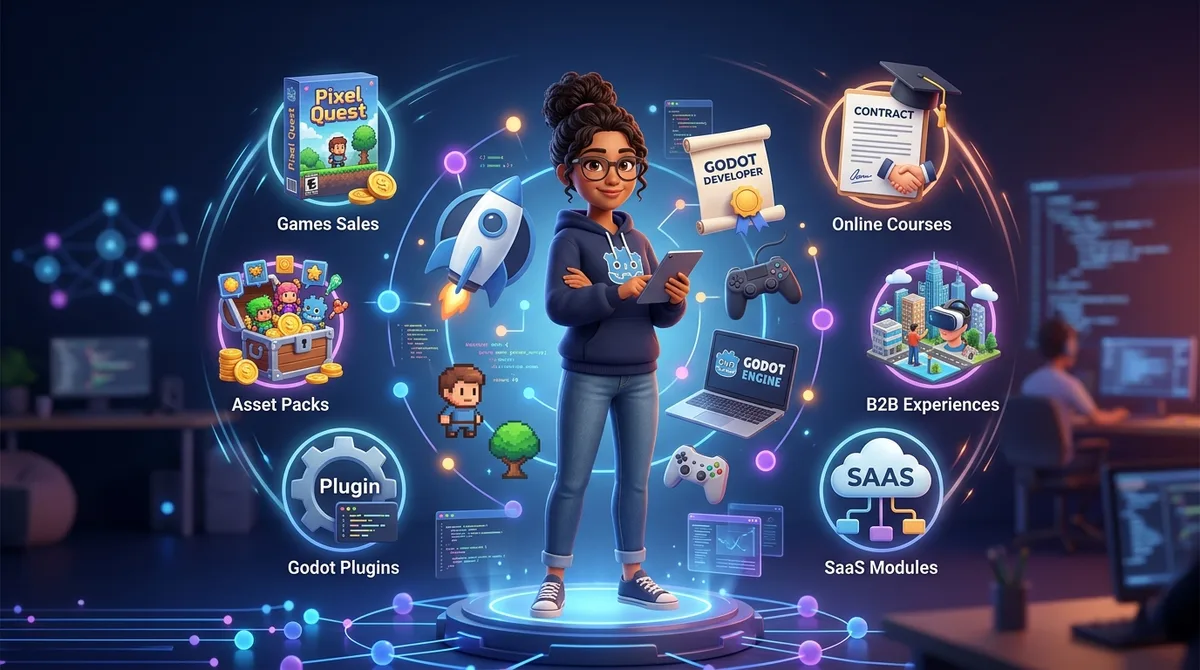
You can earn $500-$5,000/month with Godot as a solopreneur. There are 7 real monetization paths (games, assets, plugins, courses, freelance, B2B experiences, micro-SaaS). Most fail due to perfectionism, wrong model selection, and weak marketing. Start small, validate fast, build community.
Editorial Lead
In recent years, game creation shifted from being a privilege of million-dollar studios to something accessible to individual builders. Godot Engine, a completely free open-source tool, democratized game development technology. Entire communities of solopreneurs are creating real income — $500 to $5,000 monthly — using just Godot and discipline. This guide covers 7 real monetization paths that work, the structural risks that make 90% fail, and the strategies that increase your odds of success.
Introduction
You can earn between $500 and $5,000 per month creating games with Godot. But most fail.
Not from lack of ability. They fail because they confuse “learning how to use Godot” with “building a profitable business.” These are completely different things.
A technically excellent game can sell zero copies. A rough game can generate consistent income. The difference isn’t technical quality. It’s business model.
This guide covers the 7 real ways solopreneurs are making money with Godot in 2026. You’ll understand the structural risks that make 90% fail. And you’ll learn the strategies that increase your odds of success.
Read to the end. It won’t take long. And it could change your financial life.
What Is Godot Engine
Godot is an open-source engine for creating games. You use it to make 2D games, 3D games, and interactive experiences in general.
Unlike Unity or Unreal, Godot is:
- Free: No license cost, now or ever.
- Open source: Entire codebase available. You can modify the engine if needed.
- Lightweight: Runs well on weak machines. Your games will too.
- Multiplatform: Export to Windows, macOS, Linux, Web, iOS, Android.
- Active community: Tutorials, forums, discords filled with developers helping each other.
Godot isn’t “better” than Unity. It’s different. Simpler. Fewer corporate features. But completely capable of generating income.
The engine grows ~40% annually since 2022. In 2024, Godot was the most-downloaded engine in the world. More than Unity.
Why? Because it’s free and it works.
Why Godot for Solopreneurs
If you want to create income as a solopreneur, Godot has advantages other engines don’t offer.
Advantage 1: Zero startup cost
Unity charges 20% revenue above $1 million (plus fixed fees). Unreal charges 5% royalties starting at $1 million. Godot? 0%.
For a solopreneur, $0 vs. 5% is the difference between viable and impossible.
Advantage 2: Indie-focused community
The Godot community is made of indie developers. It’s not full of AAA studios complaining about missing corporate features.
You find people like you. People creating income alone. Sharing experiences.
Advantage 3: Supports multiple game types
You can make:
- 2D games (pixel art, Hollow Knight style)
- 3D games (Minecraft style, RPGs)
- Interactive experiences (not “games,” but they pay well)
- WebGL games (embeddable in websites)
Advantage 4: Practical documentation
Godot’s official documentation is focused on “how to do it.” Not on “theoretical concepts.”
It’s made by people who make games, for people who make games.
Disadvantage 1: Learning curve
If you’ve never coded, expect 2-3 months to get comfortable. Godot uses GDScript, a simple language, but it requires thinking like a programmer.
Disadvantage 2: Smaller ecosystem
Fewer pre-made assets, fewer plugins, fewer “shortcuts” compared to Unity. You’ll code more.
But for solopreneurs, that’s an advantage, not a disadvantage. Means less competition and more opportunities.
7 Real Ways to Make Money with Godot
1. Sell Complete Games (Steam, Itch.io)
The most obvious model: build a game and sell it.
How it works: You make the game (2D is more viable for solopreneurs). Publish on Steam, itch.io, or both. Set a price ($4.99 to $19.99). People buy.
To learn more about where and how to sell your digital products, check our guide to selling platforms.
Example: A simple 2D puzzle game like Baba Is You or Thirsty Suitors. Takes 3-6 months for a competent solopreneur. Costs $500-$5,000 in external assets.
Expected income: $500-$5,000/month for a well-made game with decent marketing. A bad game sells $0. A viral game can sell much more.
Risk: High. Marketing is hard. Most indie games don’t sell. You need audience or luck.
When to choose: If you’re passionate about making games. If you can wait 3-6 months without income. If you can do marketing (X, YouTube, TikTok).
2. Sell Assets and Sprites
You don’t need to make the whole game. You can sell the pieces.
How it works: You create assets (2D characters, environments, sound effects, music). Publish on Gumroad, itch.io, or Blendermarket. Each sale generates revenue (usually 50-80% goes to you).
Example: A pack of 100 enemy sprites for an RPG. Took 2 weeks to create. Costs $9.99. You sell 50/month = $500/month passive.
Expected income: $200-$1,000/month per well-made pack. You can sell multiple packs.
Risk: Low. Once created, you don’t do more work. Income is passive. Risk is just time invested.
When to choose: If you’re good at art (pixel art, 3D, design). If you want passive income.
3. Sell Godot Plugins and Scripts
Godot developers need tools. You can sell them.
How it works: You create a tool that helps other Godot devs (dialogue system, inventory manager, basic AI, etc). Sell on Gumroad, itch.io, or GitHub Sponsors.
Example: A visual dialogue system (drag-and-drop). Took 3 weeks to create. You sell it for $29.99. You sell 20/month = $600/month.
Expected income: $300-$2,000/month per popular plugin. Simpler plugins sell less. Plugins solving real problems sell more.
Risk: Medium. You need good Godot knowledge and solid programming skills.
When to choose: If you’re an experienced developer. If you can create something other devs want.
4. Create and Sell Game Dev Courses
Education scales. A course can generate income indefinitely.
How it works: You create a course like “How to Make a 2D Game in Godot” (or any topic). Sell on Udemy, Gumroad, Podia, or your own site.
Example: A course “From Zero to Your First Game in Godot” with 20 lessons. Took 3 months to create. You put it on Udemy for $49.99. You sell 100 courses/month = $2,500/month (after Udemy commission).
Expected income: $1,000-$5,000/month per well-made course. Varies greatly based on marketing.
Risk: Medium. You need to be good at teaching. You need marketing. But once created, you get paid forever.
When to choose: If you enjoy teaching. If you can create quality content.
5. Freelancer: Custom Development
Take one-off projects from clients who need custom games/experiences.
How it works: You offer development services (create a custom game for a client, consulting, mentoring). Charge by hour or by project.
Example: A company wants a custom educational game to train employees. You charge $50-$150/hour. Takes 100 hours = $5,000-$15,000.
Expected income: $50-$150/hour. With 20 hours/week = $1,000-$3,000/week.
Risk: Low-medium. Depends on finding clients. Once you have some, it’s predictable income.
When to choose: If you want quick, predictable income. If you can find clients (network, Upwork, agencies).
6. Interactive Experiences for Companies (B2B)
Not “games” in the traditional sense. Interactive experiences companies use for marketing, training, or communication.
How it works: You create interactive experiences in Godot (simulators, virtual walkthroughs, interactive presentations). Sell to companies.
Example: A real estate company wants a 3D virtual tour of a building. You build it in Godot (export as WebGL). Charge $10,000-$50,000.
Expected income: $5,000-$50,000 per project. Not monthly income, but you don’t need many projects.
Risk: Medium. You need to know how to sell (B2B is different). Need a portfolio. But prices are high.
When to choose: If you like working with companies. If you can do B2B sales.
7. Game-Based Micro-SaaS
A Micro-SaaS is software offered as a service. It can be based on game technology.
How it works: You create an online tool using game technology (Godot engine compiled to WebGL). Charge monthly subscription or per-use.
Example: A platform for “interactive simulations for e-learning.” You charge $99/month per company. With 20 clients = $2,000/month.
Expected income: $1,000-$10,000/month with scale. But it’s the most labor-intensive model.
Risk: High. You need dev skills, marketing, customer support, hosting infrastructure. It’s a real business.
When to choose: If you want to build a real business, not just side income. If you have time and resources.
Minimal Stack to Get Started
You don’t need much. Honestly.
Essential:
- Godot (free)
- VS Code (free, code editor)
- Git (free, version control — check our guide on automation and development workflows)
For art (optional at first):
- Aseprite ($20, pixel art) — or Piskel/Krita (free alternatives)
- Blender (free, 3D)
- Audacity (free, audio)
For marketing:
- Canva (free or $13/month, social design)
- OBS (free, gameplay recording)
Total cost: $0-$500 if you buy Aseprite. $0 if you stick with free tools.
Most successful solopreneurs with Godot use only free tools at first. They avoid spending.
Practical First Steps
Don’t read 50 more articles. Start now.
Week 1: Learn the basics
- Install Godot
- Do the official “Dodge the Creeps” tutorial (2 hours)
- Understand nodes, scenes, scripts
Weeks 2-3: Create a simple game
- Choose something small (Pong, Snake, Flappy Bird clone)
- Code it yourself (copying kills learning)
- Finish. Don’t perfect.
Week 4: Publish
- Export to WebGL
- Publish on itch.io (free)
- Share on X, LinkedIn, Discord
- Ask for feedback
Month 2: Choose your model
- Based on feedback, pick your monetization approach
- If “everyone loved it” → consider selling the full game
- If “concept is good but needs polish” → sell as assets or course
- If it was exhausting to make → consider freelance
Month 3: Go serious
- Start for real. Goal: first income.
It’s not scientific. It’s action.
Risks and Why 90% Fail
Let me be honest. Most fail. Here’s why.
Risk 1: Endless Perfectionism
You spend 1 year making a “perfect” game. Launch. Sell 5 copies. Lost 1 year.
Why it fails: You obsessively test. Adjust pixels. Redo systems. Never finish.
Solution: Set a deadline. 3 months. Done. Launch with bugs if needed.
Risk 2: Wrong Monetization Model
You want to sell games. But the market wants courses. You spend 6 months. Sell nothing. Quit.
Why it fails: Didn’t validate the market before investing 6 months.
Solution: Before starting, validate: make a prototype. Publish on itch.io. See interest. Then pick your model.
Risk 3: Weak Marketing
You make a good game. Launch. Nobody knows. Sell zero.
Why it fails: Thought “good games sell themselves.” They don’t.
Solution: Start marketing BEFORE you finish the game. Build community while developing.
Risk 4: No Financial Runway
You quit your job. Want to live off game dev. Month 3, no income. Panic. Go back to work.
Why it fails: Didn’t have 6-12 months of savings.
Solution: Start as a side hustle. When it generates consistent income, leave your job.
Risk 5: Wrong Scope
You try to make a 3D AAA game in Godot. Takes 2 years. Impossible as a solopreneur.
Why it fails: Didn’t choose appropriate scope.
Solution: Start with 2D. Or very simple 3D. Scale later.
Risk 6: Isolation
You work alone. Nobody to discuss with. Get stuck. Quit.
Why it fails: Solopreneurship is psychologically hard.
Solution: Find community. Godot Discord. Indie game devs on X. Accountability partner.
Success Strategies
If you understand the risks, here are strategies that work.
Strategy 1: Validate Before Executing
Before spending 3 months on a game, validate your idea:
- Research: Is there interest in this?
- Prototype: Build something very simple in 1 week
- Publish: Put it on itch.io
- Get feedback: See if people care
- Then start: Begin for real
This takes 2 weeks. And saves 2 months of wasted work.
Strategy 2: Start Small, Scale
Your first game doesn’t need to be good. It needs to exist.
- Game 1: Small, quick (6-8 weeks)
- Game 2: Medium, more ambitious (3-4 months)
- Game 3: Your “masterpiece” you actually monetize
First half is learning. Second half is profit.
Strategy 3: Multiple Income Streams
Don’t put all eggs in one basket.
If you only sell games and no game sells, you’re stuck. But if you:
- Sell 2 games (generates $1,000/month)
- Sell courses about how you made them (generates $800/month)
- Do 10 hours/week of freelance (generates $600/month)
Total: $2,400/month. And if one fails, others cover.
Tip: You can use AI agents to automate parts of your workflow and free up more time.
Strategy 4: Community Is Your Greatest Asset
Someone with 10k followers who genuinely care about your work doesn’t need to worry about marketing.
Start building community NOW:
- Post progress on X (screenshots, devlogs)
- Create Discord for interested people
- Respond to messages (seriously)
- Build relationships, not just an audience
When you launch, these people buy.
Strategy 5: Focus and Depth
Don’t try to be good at everything. Pick one thing and master it.
If you choose “2D educational games,” stay there. Learn everything about e-learning. Know the market. Master it.
Then expand.
People trying “everything” don’t become excellent at anything.
Conclusion
Godot is viable for creating income as a solopreneur. It’s not easy. But it’s viable.
You have 7 paths. Pick one. Start today.
Most fail because:
- They perfectionism infinitely
- They choose the wrong model
- They do weak marketing
- They quit too soon
If you avoid these 4 mistakes, your odds increase 10x.
Here’s your next step:
Today: Install Godot. Do the “Dodge the Creeps” tutorial.
Next week: Create a small game (Pong, Snake, something simple).
Week 3: Publish on itch.io.
Month 2: Choose monetization model based on real feedback.
Month 3: Go serious.
Don’t read more guides. Start now. Action teaches you more than any text.
Good luck.
FAQ
Q: How long until I make money? A: Depends on model. Selling games: 6-12 months. Courses: 3-6 months. Freelance: 1-2 months. Assets: 1-2 months. No guarantees.
Q: Do I need programming skills? A: GDScript is simple. Know basic logic? Learn in 2-4 weeks. Never coded? 2-3 months of serious study.
Q: Godot vs Unity vs Unreal? Which to choose? A: For solopreneurs: Godot. Free, indie community, practical docs. Unity charges royalties. Unreal is overkill.
Q: Which monetization model should I choose first? A: Start by validating. Build a prototype. Get real feedback. If they love the game → sell it. If they like the concept but it needs polish → courses. If it was exhausting → freelance.
Q: Where do I find community? A: Official Godot Discord. Reddit r/godot. X (#godotengine). YouTube (Brackeys, GDquest channels).
Q: Can I earn part-time? A: Yes. 10-15 hours/week is enough if focused. 20+ hours accelerates progress.