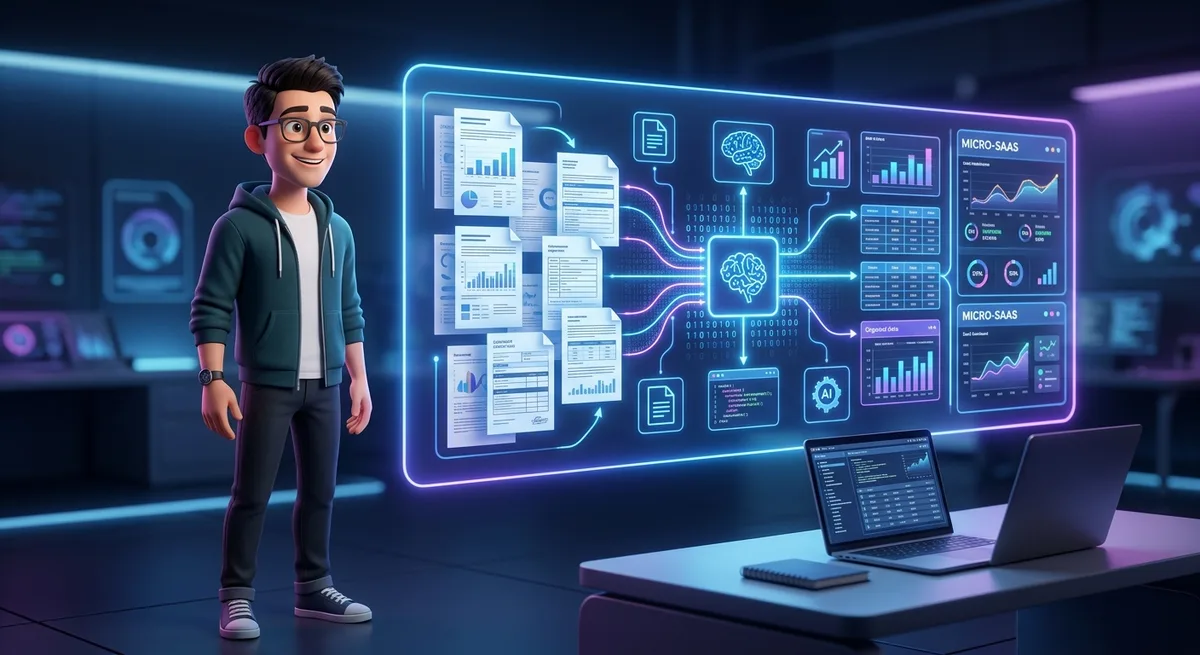
TL;DR: GLM-OCR is an open-source OCR model that extracts text, tables, and structures from documents with 94.62% accuracy. For solo builders, it opens doors to creating automation pipelines and micro-SaaS that process documents at scale — without a team.
Have you ever needed to extract data from hundreds of invoices? Convert scanned contracts into editable text? Process batch invoices?
If yes, you know the manual work involved.
GLM-OCR solves this. And more: it gives you the foundation to create products that monetize this capability.
What is GLM-OCR
GLM-OCR is a multimodal OCR (Optical Character Recognition) model developed by Zhipu AI. It’s not just a “text reader” — it understands layout, structure, tables, and even mathematical formulas.
Numbers that impress:
- 94.62% score on OmniDocBench
- 0.9B parameters (lightweight, runs on modest GPU)
- Supports vLLM, SGLang, and Ollama
- Cloud API available (no local GPU needed)
Unlike traditional OCRs that only return plain text, GLM-OCR returns:
- Structured Markdown
- JSON with detailed layout
- Table detection
- Code recognition
from glmocr import parse

# Extract text from an image
result = parse("contract.pdf")
result.save(output_dir="./result")
That simple.
Why This Matters for Your Income
Documents are everywhere. Invoices, contracts, receipts, certificates, reports, forms.
Most companies pay dearly to process this manually. Or use expensive enterprise tools.
As a solo builder, you can create an automation pipeline that:
- Receives documents (upload, email, API)
- Extracts data automatically
- Returns structured (JSON, spreadsheet, database)
- Charges per volume or subscription
That’s a micro-SaaS.
Practical Use Cases
1. Accounting Automation
Accountants process hundreds of documents daily. Invoices, receipts, statements.
With GLM-OCR, you create a pipeline that:
- Receives NF-e in PDF
- Extracts: CNPJ, amount, date, products, tax
- Returns JSON or inserts directly into the accountant’s system
The accountant pays $50-200/month for this service. No team required.
2. Human Resources
HR needs to digitize employee documents: ID, tax ID, proof of address, contracts.
A pipeline that:
- Classifies documents automatically
- Extracts data and populates spreadsheet
- Alerts about missing documents
Micro-SaaS at $30-100/month per company.
3. Real Estate
Lease agreements, deeds, property tax bills. Everything on paper or scanned PDF.
Your tool extracts:
- Property address
- Rent amount
- Contract period
- Party names
Resells as spreadsheet or system integration.
4. Legal
Lawsuits contain hundreds of pages. Extract appeals, motions, dates, amounts.
Tools for lawyers can charge $200-500/month for petition analysis.
How to Implement (Practical Level)
Installation
# Option 1: Cloud API (no GPU)
pip install glmocr  # PyPI: https://pypi.org/project/glmocr/

# Option 2: Self-hosted (vLLM)
pip install "glmocr[selfhosted]"
Cloud Configuration (Fastest)
# config.yaml
pipeline:
  maas:
    enabled: true
    api_key: "your-api-key"
from glmocr import GlmOcr

with GlmOcr() as ocr:
    result = ocr.parse("document.pdf")
    print(result.json_result)
Self-Hosted Configuration (Cheaper Long-term)
# Run vLLM
vllm serve zai-org/GLM-OCR --allowed-local-media-path / --port 8080 --served-model-name glm-ocr  # Model: https://huggingface.co/zai-org/GLM-OCR
# config.yaml
pipeline:
  maas:
    enabled: false
  ocr_api:
    api_host: localhost
    api_port: 8080
Complete Pipeline
import os
from glmocr import GlmOcr

def process_folder(folder):
    """Process all PDFs in a folder."""

    with GlmOcr() as ocr:
        for file in os.listdir(folder):
            if file.endswith(('.pdf', '.png', '.jpg')):
                result = ocr.parse(os.path.join(folder, file))

                # Save JSON
                name = file.rsplit('.', 1)[0]
                result.save(output_dir=f"./result/{name}")

                print(f"Processed: {file}")

process_folder("./documents")
Micro-SaaS Ideas with GLM-OCR
1. OCR-as-a-Service
Simple API that receives image/PDF and returns structured JSON.
Monetization: $0.01-0.05 per document + subscription.
Differential: Focus on Brazilian layout (NF-e, contracts).
2. NF-e Digitizer
Receives NF-e in XML/PDF, extracts data and populates spreadsheet or integrates with accountant.
Monetization: $50-200/month for accounting firms.
Differential: Specific template for Brazilian accounting.
3. Contract Analyzer
Upload contract → extract clauses → summary + alerts.
Monetization: $30-100/month for freelancers or small businesses.
Differential: Focus on common contracts (lease, service agreement).
4. Real Estate Data Extractor
Process deed, property tax, lease agreement. Extract and organize data.
Monetization: $100-300/month per real estate agency.
Differential: Integration with real estate management systems.
Monetization Strategies
B2B: Charge by Volume
Model: Pay-per-use or monthly subscription.
Example:
- 1,000 documents/month = $49/month
- 10,000 documents/month = $199/month
Ideal for: accountants, law firms, real estate agencies.
B2C: Flat Subscription
Model: $10-30/month per user with document limit.
Ideal for: freelancers, professionals, small businesses.
Marketplace: Processed Data
Not just selling OCR — selling organized data.
Example:
- “Invoice database from sector X”
- “List of rental contracts in region Y”
This has value for researchers, journalists, market analysts.
White-Label
Offer the technology for other companies to use with your brand.
Model: Reseller or licensing.
Next Steps
Day 1-2: Setup
pip install glmocr
# Create account at open.bigmodel.cn
# Get API key
Day 3-5: MVP
Create a simple pipeline that processes one document type.
Test with 10-20 real files.
Day 6-7: Validate
Show to potential customers. Capture feedback.
If they don’t pay, pivot or abandon.
If they pay, continue.
Week 2: Automation
Add:
- Upload via web interface
- Result storage
- Webhook integration
Week 3-4: Monetization
Define pricing. Create product page. Launch beta.
FAQ
Is GLM-OCR free?
The model is open-source (MIT). You can run it locally for free. The cloud API has usage-based cost.
Do I need a GPU?
For self-hosted, yes. A GPU with 6-8GB VRAM is sufficient. For cloud API, no.
What’s the difference from Tesseract or other OCRs?
Tesseract is rules-based. GLM-OCR uses deep learning, understands context, tables, and complex layouts. Accuracy is significantly higher.
Can I use it commercially?
Yes. The model is MIT. You can build commercial products on top of it.
How much does self-hosted cost?
A cloud GPU (AWS, RunPod) costs $0.30-0.50/hour. For light use, $10-30/month.
What’s the best pricing model for data extraction services?
You can charge per document ($0.10-0.50), monthly volume packages (100-1000 docs), or subscription ($50-500/month for B2B). The B2B model (per company) usually generates more recurring revenue.
Can GLM-OCR extract data from Brazilian invoices (NF-e)?
Yes. GLM-OCR understands Brazilian document layouts. NF-e extraction includes: issuer/recipient CNPJ, amounts, items, taxes. The JSON output makes it easy to integrate with accounting systems.
Can I use GLM-OCR to process contracts automatically?
Yes. The model extracts clauses, dates, amounts, and parties involved. You can create a pipeline that summarizes contracts and alerts on expiration dates.
Conclusion
GLM-OCR isn’t just another OCR model. It’s infrastructure that lets you create data extraction products at scale — without an engineering team.
The opportunity lies in verticalizing:
- Don’t be “another OCR”.
- Be “OCR for accountants” or “OCR for real estate” or “OCR for legal”.
The B2B market pays for solutions that solve specific problems. Start small, validate fast, scale what works. To automate your workflow even further, consider using AI agents.
Need help building your pipeline? Tell me in the comments which document you most need to process.